Pages

Showing posts with label art. Show all posts

01 February 2026

The heart of the Andes

 There is painting of the American artist Frederic Edwin Church, titled 'The Heart of the Andes' that I had set as my laptop desktop background image for a couple of years now. 


Initially I thought the painting was 'The Church in the Andes'... I had mixed up the name of the artist and the art piece itself. Today while reading something more about the same painting I learnt that it was a tribute to the philosopher naturalist Alexander von Humboldt. So basically it is a piece of art depicting nature. The title given to the painting also is this justified - nature being the most prestigious element of South America. 

Nonetheless, I found asking myself, what is the cross doing in that painting? More specifically, what is the cross doing in the HEART of the Andes? One could brush aside this question attributing the cross in the painting to the artist's colonial and Catholic affiliation. Perhaps there is an element of truth there. But why is it there at all? That too in that size. The cross isn't central. Neither large nor immediately evident. It is part of the whole natural landscape. But it is there!

I interpret it as God being part of one's heart. Not overriding or displacing everything else, but an integral element. Greater still is the artist's depiction of the people in the painting: near the cross. Not bathing, not working in the field, not elsewhere. 

In a way the painting is, for me, a microcosmic depiction of the human being: the human as one tiny part of nature and reality; and at the same time a macrocosmic aspect: God at the heart of all reality.

15 August 2025

Google Doodle summarises India today

 The Google doodle on the occasion of the Indian Independence day of this year is an interesting summary of what India stands or means for the rest of the world... as of today: 

Illustrated by Makarand Narkar and Sonal Vasave

There's the space expeditions, cricket, chess, and pottery art (Jaipur). This is a rather neat summary of what India is all about today!  

Of course, there could a million other things that could have been depicted, but given the limited scope, I think this collage is a rather decent depiction of features that best describe India today. 

07 April 2025

Photography

A couple of months ago when there was a discussion about the selection of photos for the wall calendars and other annual reports or documentation, I made a point: insert or use only those photos which show or capture the natural scene... not a posed or orchestrated still. 

I understand the value and need of posed photos.  But when it comes to showing life and living in its best form, pictures that speak have far more value and add meaning to the text or context.  

I have before me a wall calendar with a photo of a group of women around a tailoring gadget.  It clearly shows an instructor speaking to a dozen women about the work or tailoring skill. It could have been a posed photo, wherein the cameraman or  someone may have asked them to gather around. But the beauty of the photo is that not one among those in the photo are worried or facing the camera.  Each one is so engaged in the words and instructions of the tutor that tells how profoundly they are interested in the skill or art of tailoring.  Their faces endorse the fact that there is training happening!!! That trainees are passionate about their training!  That the instructor is an engaging person.  


22 January 2025

Tying our own feet...

More than ever, I've come to realise that the more we invest in infrastructure, the more we are tying down our own selves, especially in terms of our apostolate. With our ever increasing craze to build structures, even with already built buildings lying idle or under utilised, we tend to push for newer buildings. 

The skewed logic being: We needed the space, so we built. But over the years, the numbers are constantly dwindling and in quite a few places we hardly have any resident students or boarders. And since the building is there, we feel the need to fill it up with children. Even if the need isn't that or has totally changed.  So the reason for staying behind and doing the same work as before is that there is the building!!  

I'm reminded of an incident in Hollywood which struck me very deeply...Ward Kimball was an animator for the Walt Disney Studios in the 1930’s. He was on the team for the first full-length animated feature by the Disney studio, Snow White and the Seven Dwarfs (1937).

He spent 240 days working on a single four-and-a-half-minute scene. In that scene, the dwarfs were cooking a meal for Snow White, and he covered every detail. When the time came, to review the film, Walt Disney personally reviewed the scene and commented: “That scene is hilarious. It’s terrific.” 

Then, he added, “But, I think it interrupts the flow of the movie so we need to cut it out!” 

So off went that scene - 240 days of immense work, scrapped in order to preserve and enhance, the greatness of the film! 


I wish we had that courage and vision of Ward Kimball to be able to see the greater picture and adapt accordingly, however painful it may be. 


I managed to get a clip of the same production... 

02 September 2020

Sanctity and humour

 I'm not an artist or one to really comment on art, but could not help but notice the fact that most of the historical paintings of eminent artists, especially of the Biblical figures, are all very serious and tense.  One hardly comes across Biblical characters in a lighter mood or appearing really happy.  There is always a sort of tension prevailing within that gets reflected on the face. 

It is hard to imagine that all those Biblical characters or the saints of the past did not know how to smile or be happy.  Could not have been so - after all, they were all human and in most cases, convinced and passionate about their commitment. Of course, all of them did have to face a lot of trials and tribulations, but even those they gladly embraced.  Those difficulties did not count much in the face of their primary choice for God and His people.  So why the long, sad, brooding face?? 

I'm guessing such paintings were in a way reflecting the inner tension of the artist himself or herself.  Especially of paintings which portray great depth and personality, the artist must have really drained him/herself out to be filled in with the person he or she is painting.  That's a heavy toll on oneself.  So evidently that pours out through the brush and the expression.  But I suppose, in reality, these Biblical characters and Saints whose numerous paintings we come across were men and women of good cheer and humour.  Difficult to imagine otherwise!

14 May 2020

A fresh Don Bosco from an old window

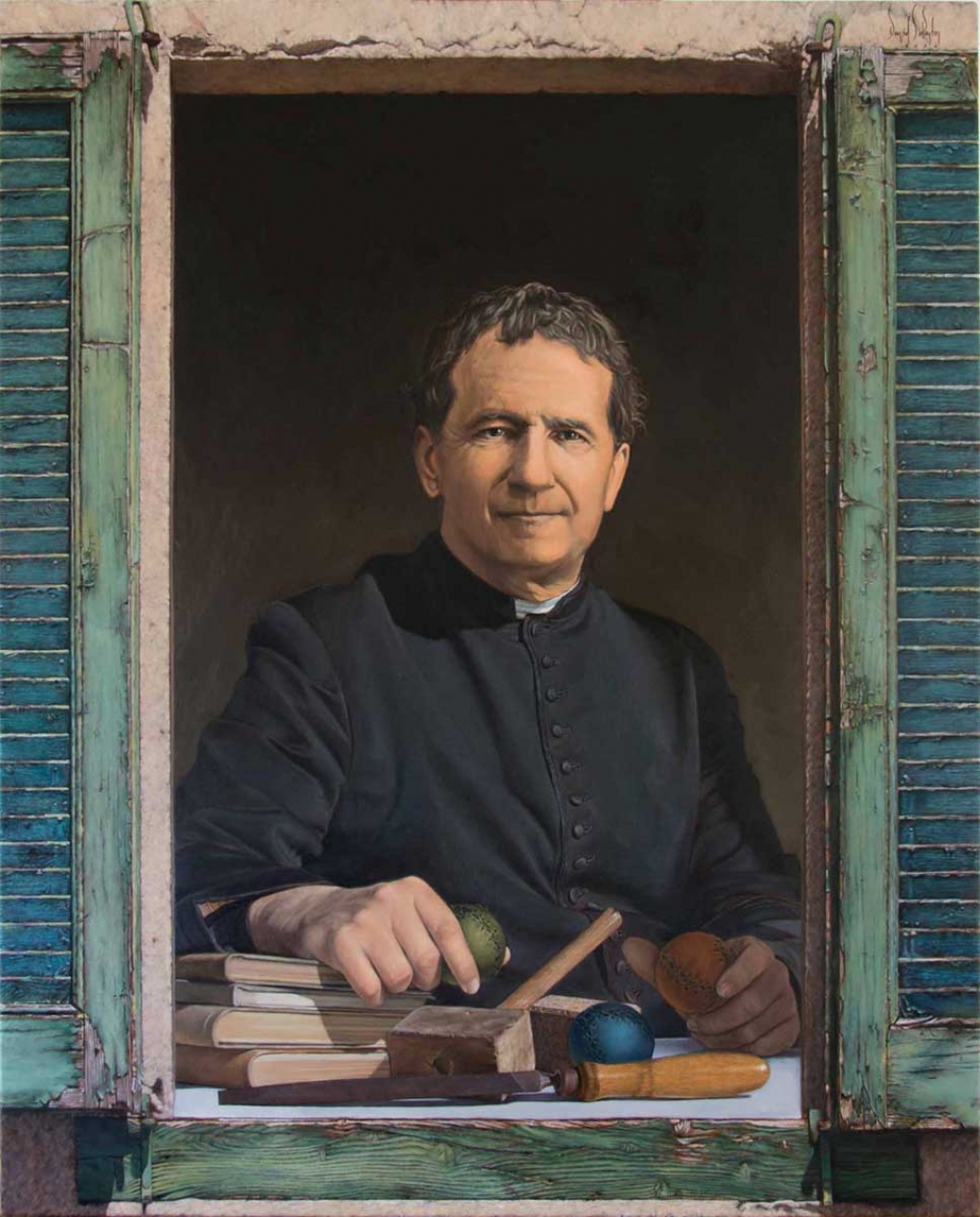
A new painting of Don Bosco from an artist in Alicante, Italy shows him gazing out of his window at Valdocco.  Interestingly it has a very significant connection to the present times. 

The artist, David Pastor Corbi, a former arts teacher at the Salesian institute in Alcoy (Italy) said he was requested to draw a portrait of Don Bosco in 1999 by the then provincial of Valencia, David Churio.  But somehow it never got materialised.

David states,
I've thought about it a long time and I decided to represent Don Bosco in his room, looking outside Valdocco, through the windows with their picturesque and characteristic green painted shutters.  I decided that they would be made as if they'd never been closed and being always open made them seem very damaged by the inclement weather.
However, the Covid-19 lockdown gave the last phase of the creative work a twist.  In the words of David,
When the moment of confinement due to Covid-19 arrived, that green shutter changed its symbolism; it became a point of hope and confidence in the future, while books, balls and tools became a model of behavior.
I personally liked the look on his face!
It's an expert's gaze, intense for the hard work done and for what there is still to be done; there's so much strength, despite the years that weigh it down,
[From the ANS

01 December 2019

BreXmas

Good one merging Christmas and Brexit...

(The Telegraph 27 October 2019) 

18 October 2019

Growing up

Came across a new children's book gathering attention.  It is by Charlie Mackesy who actually began to put up he sketches on instagram.  Liked the following picture... and the message:
Photo taken of The Times (Oct. 17, 2019).  Inset photo of Charlie Mackesy

21 March 2018

Focus of the click

There was a time not so long ago when photography was an art - an art not the be messed with.  So there was a sense of proportion, angle, symmetry, and a whole list of do's and don'ts that was part of photography.  Then there was a whole list of things one would photograph - basically people.  Anything else was considered a waste of precious time, energy, talent and resources.  However, whenever I visit tourist spots or am with a group of tourists (among whom there are invariably a couple of them who have hi-tech cameras), I cannot but notice the "odd and strange" things they photograph. 

Of course, the whole notion of art has evolved and technology has adapted.  But I wonder what would the pioneers of photography have said about this person who was photographing a dustbin?  He certainly must have seen something novel... hopefully.
Watching him click away the dustbin, and me being unable to resist the temptation of clicking him in the act, I was reminded of our picnic to Velankanni while studying at The Retreat, Yercaud, two decades ago.  Fr Amalaraj, the rector had a camera and once in a way he would exhibit his generosity by asking some Brothers to pose.  And boy, he did have a pose himself!  Soon, the requests for photos increased, especially from a select few.  Only later did he realise that this select group was coaxing him to take the photos so that the Assistant (who had the only other camera) could click him in his various comic postures of clicking photos! 

06 January 2018

Cave paintings and emojis

Mankind took centuries and ages of painstaking effort to evolve communication and language from the earliest animalistic grunts and cave paintings.  Years of study and research has seen the development of syntax, grammar, spelling, dictionaries, translations and what not... all to polish language and make it more sophisticated.  In such a context it is amazing to see the use of language on social media, especially the ones most in use (twitter, facebook, whatsapp...).  Grammar has gone for a toss.  So have spellings. Words are shortened and abbreviated (euphemism for murdered and butchered!).  And most often there are hardly any words or letters... only emoji.  So much so, the word 'emoji' was announced as the word of the year in 2015 by Oxford dictionary!  Back to the age of cave paintings! But I guess pictures have always been a more powerful means of communication than words.

03 September 2017

Art or accident?

A very fine work of art or an accident?  Received this pic on one of the whatsapp group, so was keen to find out myself.  Interesting find!
Artist: Giulia Bernadelli
Read and view more... here.

24 May 2017

Crucifix (Farnborough)

Along the corridors and common rooms of the Salesian house here in Farnborough, there are several lovely paintings and works of art.  This particular crucifix outside the Chapel has somehow been catching my eye, every time I pass that corner.  

18 May 2017

London graffiti

During my previous visits to London too I did notice something that I've not found in these rural parts where I live: graffiti.  As one approaches the city of London, one gets to notice the graffiti all around the place.  I know not if it has been 'upgraded' or acknowledged to be part of street art, but it does have a creative bend to it.

Of course, not all of what is expressed is any way worth mentioning, but the art dimension cannot be neglected.  Perhaps some of it can very well be classified under calligraphy!


21 February 2017

Of equity and equality

I had an interesting conversation with someone this afternoon about the British being more fond of equity than equality.  Equity is understood as fairness, being impartial.  Whereas equality is considered as something similar and akin.  The point of the discussion was justice.  In the light of this, the notion of equity makes more sense than equality.

I have to acknowledge, that my "Indian historical background" - the euphemistic phrase for 'British colonizing India' - didn't let me really listen well to the British fondness for fairness and equity.  Nonetheless, I did find the argument persuasive and relevant.  Moreover I was told that equity is a constitutional goal found in the official documents of the country, especially the Magna Carta.

We can never be all equal.  We can talk of equal opportunities and possibilities, but that's more about equity than equality.  Each of us is unique and different from the other. On no account can any group be said to be equal with another.  Of course, that does not give any one or any group ascendancy/superiority over another.

However, here's a nice pictorial presentation with a different message...


These pics say a lot about how we think - or are used to thinking!  

26 January 2017

Caricaturing opponents

On treatment of opponents, here's a quote of Nietzsche (Will to Power, § 374)
Every society has the tendency to reduce its opponents to caricatures-at least in imagination-and, as it were, to starve them. Such a caricature is, e.g., our "criminal." Within the aristocratic Roman order of values, the Jew was reduced to a caricature. Among artists, the "philistine and bourgeois" become caricatures; among the pious, the godless; among aristocrats, the man of the people. Among immoralists it is the moralist: Plato, for example, becomes a caricature in my hands. 

07 November 2016

Torn between...

Two subjects or disciplines that really have had a sway on Philosophy - Western philosophy - right since the beginning are science and art.  While the ancient Greek pioneers were all scientists and mathematicians, the later breed were artists.  On the one hand there is this innate desire to systematize philosophy as a well organised structure, as science is (all black and white, logical, clear cut, definite, understandable...).  People like Descartes, Kant and Heidegger have done their bit quite heroically.

On the other hand there is the attempt to liberate philosophy and make it creative and free... like art or poetry.  Wherein rules are not the most important but the content of what is said.  Not everything needs to be clear-cut or well within grasp. Not necessary that there are set standards to which anything and everything must abide by.  Artists, mystics, poets, have in their own way shown the path.

Now which of these two paths is the way forward? Thinking otherwise, why should philosophy be like science or art at all?

08 February 2013

Creative designs

This time at the Provincial house, there was some good artistic work by Br Ashish (from Odisha).  Though with his right arm in the sling, he did create some good and creative art work for the statue of Don Bosco and the around in the altar in the Chapel.  Here are the photos.

04 December 2012

Obsessed with faces

Very many of us are obsessed with a face, with a complete figure of who we want to see.  Take for example, my Brothers, some of whom I gave the whole backdrop design for the Seminary Day. Along with the text there was also a picture - just an outline or sketch - of Jesus with His disciples.  Come the last day, on the backdrop I see a Jesus with a face and cassock and red sash and all the disciples in colourful attire, each with a distinctive face!  My picture had none of it - yet anyone viewing that picture would not hesitate a bit to say that it is Jesus and His disciples.

While I was in the Provincial house, I remember designing an Easter meal invitation for some guests, one of whom was a retired Mandal Revenue Officer (MRO). The invitation contained a picture - again one without all the facial features clearly etched out - of the risen Lord.  This particular gentleman could not understand how could this be called an invitation without the face of Jesus clear ('He does not have eyes or a nose!' is what he exclaimed).

Perhaps when the inside is empty, the outside needs to complement it; but if the  inside is 'insightful' and the heart sees, even a simple line speaks volumes! 

31 August 2010

Art, Pain and Dreams

It is said that the French artist Pierre-Auguste Renoir was one who would not give up painting even in his last stages of life when due to severe rheumatism he could not even hold the painting brush. His desire to create beauty was far greater than the excruciating physical pain he had to endure.
The pain I suffer now is temporary but the beauty I create is for eternity.
Not very many people have the courage to endure pain and carry on with life or even dream and strive for something more, in those times of pain. But those who do carry on are either lunatics or great visionaries. But blessed are they whose pain gives them the strength to go on and whose dreams gives them the hope to fight on.
Related Posts Plugin for WordPress, Blogger...